Posted on — 1 Comment

Nixie Clocks: How They Work and How to Choose One

A nixie clock shows the time with nixie tubes: vintage glass tubes in which each digit glows orange. Here is how these clocks work, and what to look at before buying one.

How a nixie clock works

A modern nixie clock combines nixie tubes with up-to-date electronics: a microcontroller that drives the display, a quartz crystal or a GPS/WiFi signal for accurate time, and a small high-voltage supply that turns the safe low-voltage adapter into the roughly 170 V the tubes need. The result is a vintage display with modern features.

What to look for when buying

The tubes

  • Number of tubes: four tubes show hours and minutes; six add the seconds. Single-tube clocks show the time digit by digit.
  • Size: compact tubes such as the IN-14 suit a desk; large tubes such as the IN-18 or ZM1042 are readable across a room.
  • Origin: most tubes are new old stock – vintage, never used. A few, like the Dalibor Farny R568M, are hand-made today.

Features that protect the tubes

  • Anti-cathode-poisoning routine that regularly cycles every digit
  • Night mode to dim or blank the display at night
  • Motion sensor that switches the tubes off when the room is empty

Timekeeping and comfort

  • Accurate time: quartz crystal, with optional GPS or WiFi synchronisation
  • A daylight saving time button, so you do not have to reset the clock twice a year
  • Backup that keeps the time through short power cuts
  • Programmable backlight if you like colour under the tubes

Build, safety and support

  • Enclosed electronics and a mains adapter suited to your country
  • A real warranty and a maker you can contact
  • A case you like: clear acrylic or plexiglass shows the electronics, steel gives an industrial look, aluminium a modern one

Which Nixie Boulevard clock?

Every clock is assembled by hand in Paris, ships worldwide and comes with a 1-year warranty. Still hesitating? Ask me.
Posted on — Leave a comment

VFD vs Nixie Tubes: What Is the Difference?

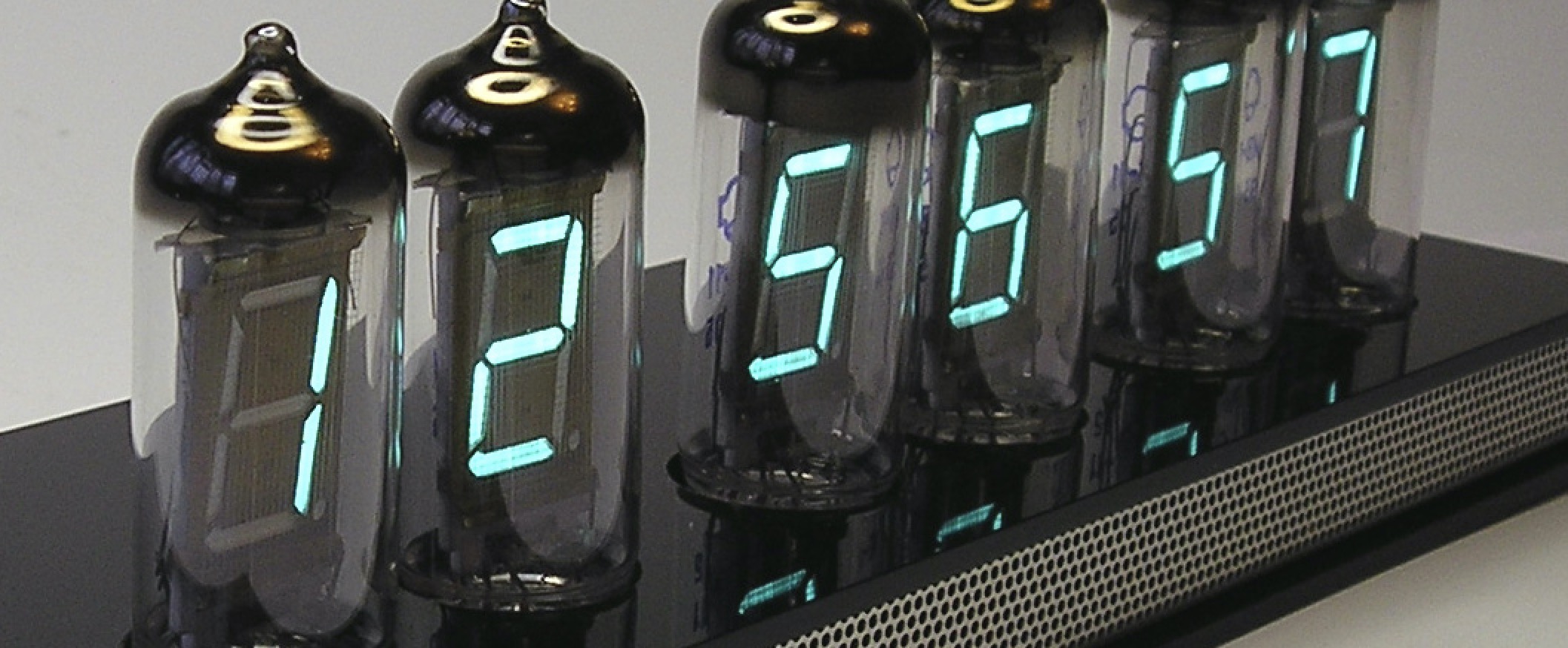
A vacuum fluorescent display (VFD) vfd clocks

Vacuum fluorescent displays (VFDs) and nixie tubes both give a clock a retro glow, but they work in very different ways and do not look the same. Here is what sets them apart.

How a VFD works

A VFD is a vacuum tube containing a very thin heated filament (the cathode), a fine control grid and anodes coated with phosphor, usually shaped as segments. Electrons emitted by the filament strike the phosphor-coated segments, which glow – most often in blue-green. VFDs run on low voltages, a few tens of volts. Developed in Japan in the late 1960s, they became everywhere in the 1970s to 1990s: calculators, hi-fi equipment, video recorders, microwave ovens, cash registers and car dashboards. Soviet tubes such as the IV-11, a seven-segment VFD, are popular with clock makers.

How a nixie tube works

A nixie tube contains no filament. Ten metal cathodes shaped like the digits 0 to 9 are stacked inside a tube filled with neon. At about 170 V, the gas around the selected cathode glows orange, lighting up a complete, real digit.

Nixie vs VFD at a glance

Nixie tube VFD
Principle Glow discharge in neon gas Phosphor lit by electrons in a vacuum
Digits Complete numerals, stacked at different depths Segments in a single plane
Colour Warm orange Blue-green (other colours with filters)
Voltage About 170 V DC Low: a few tens of volts, plus the filament supply
Look Vintage, three-dimensional Retro-electronic, crisp and flat

Which one should you choose?

It is mostly a matter of taste. VFDs have a crisp, cool, eighties look. Nixie tubes, with their warm glow and three-dimensional digits, are the classic choice for a statement clock – and the one we specialise in. All our clocks are nixie clocks, assembled by hand in Paris; for a VFD project, ask me.

Posted on — 1 Comment

Numitron vs Nixie Tubes: What Is the Difference?

numitron clock

Numitrons and nixie tubes both come from the era before LEDs, and both make beautiful clocks. But one is a tiny light bulb, the other a neon lamp. Here is the difference.

What is a numitron?

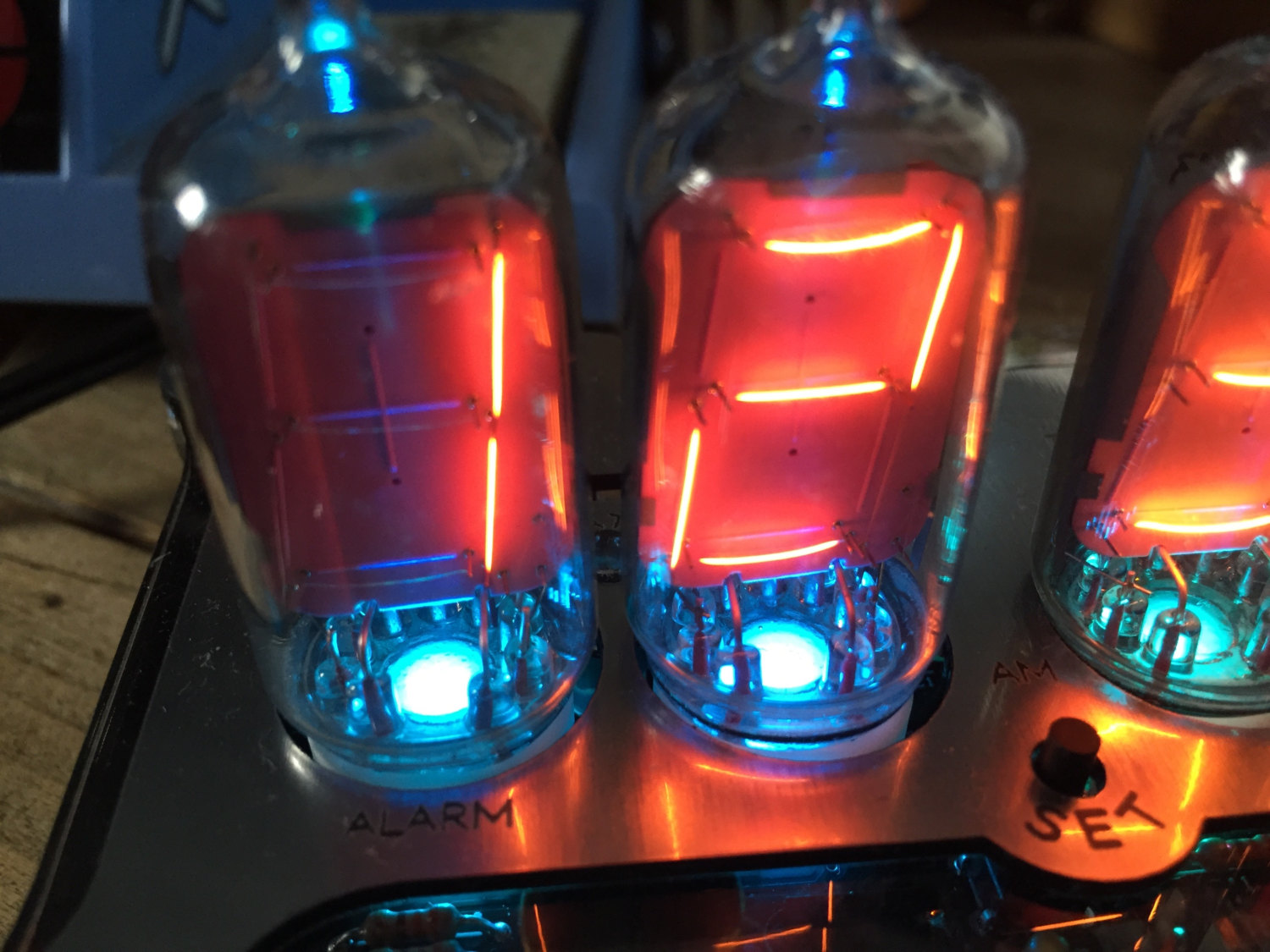
A numitron is an incandescent display tube. Inside a small glass vacuum tube, seven thin filaments are arranged as a seven-segment digit, usually with an eighth for the decimal point. When current flows through a filament, it heats up and glows, exactly like the filament of a light bulb. RCA sold these tubes under the Numitron name in the 1970s; Soviet equivalents include the IV-9 and IV-13. Numitrons run on a few volts and are simple to drive, and their filaments remain visible inside the glass when switched off.

How is a nixie tube different?

A nixie tube has no filament. Ten metal cathodes shaped like the digits 0 to 9 are stacked in a tube filled with neon. At about 170 V, the gas around the selected cathode glows orange and lights up a complete digit.

Numitron vs nixie at a glance

Numitron Nixie tube
Principle Incandescent filaments Glow discharge in neon gas
Digits Seven segments Complete numerals, stacked at different depths
Colour Warm white to amber Warm orange
Voltage A few volts About 170 V DC
Look Fine glowing wires, very delicate Vintage, three-dimensional digits

Which one should you choose?

Numitrons have a delicate, almost jewel-like look; nixie tubes have the iconic orange glow and full numerals that most people picture when they think of a vintage clock. We specialise in nixie clocks, assembled by hand in Paris – ask me if you are looking for something else.

Posted on — Leave a comment

What Is a Nixie Tube? How It Works, History and Lifespan

nixie tube

A nixie tube is a small glass display tube that shows a digit as a glowing orange numeral. Invented in the 1950s, it was the standard way to display numbers on electronic instruments until LEDs replaced it in the 1970s. Today nixie tubes are prized for their warm light – and they are the heart of every Nixie Boulevard clock.

How a nixie tube works

Inside the glass envelope, ten thin metal cathodes, each shaped like a digit from 0 to 9, are stacked one behind the other in front of a fine wire-mesh anode. The tube is filled with neon gas at low pressure. When a voltage of roughly 170 V DC is applied between the anode and one cathode, the gas around that cathode glows: the digit lights up in orange. Switching to another cathode lights another digit. Because the digits are stacked, each one appears at a slightly different depth – part of the charm of a nixie display.

A short history

The tube was developed by Haydu Brothers Laboratories, a small vacuum-tube maker acquired by the Burroughs Corporation, which introduced it in 1955 under the name Nixie – said to come from “NIX I”, for Numeric Indicator eXperimental No. 1. Nixie tubes were used in calculators, voltmeters, frequency counters and early computers. In the 1970s, cheaper LED and vacuum fluorescent displays running on lower voltages replaced them, and production stopped in the West. In the Soviet Union, nixie tubes such as the IN-14 and the IN-18 were produced for longer – which is why most nixie tubes available today are Soviet.

New old stock and new tubes

“New old stock” (NOS) means genuine vintage tubes that were manufactured decades ago but never used. Their supply is finite, which is why large tubes like the IN-18 are becoming rare. A handful of craftsmen make new nixie tubes today – among them Dalibor Farny in the Czech Republic, whose giant R568M tube powers our Solitube.

The tubes in our clocks

  • IN-14 – a compact Soviet tube with 18 mm digits, used in our desk clock.
  • IN-18 – the largest classic Soviet nixie, with tall, elegant digits, used in our six-tube clocks.
  • ZM1042 – a rarer tube with large digits, used in our ZM1042 clock.
  • R568M – a giant tube hand-made today by Dalibor Farny.

How long does a nixie tube last?

Lifespan depends on the tube and on how many hours it is lit. The main enemy is cathode poisoning: digits that are rarely lit slowly get covered by material sputtered from the active cathode and stop glowing evenly. Good clocks prevent it by regularly cycling every digit (the “slot machine” effect), and extend tube life further with a night mode and an optional motion sensor – features built into every Nixie Boulevard clock.

Are nixie tubes safe?

Yes, in a properly built clock. The high voltage the tubes need is generated inside the case from a low-voltage adapter, and the electronics are enclosed. Simply never open a clock while it is plugged in.

See our nixie clocks · Nixie clock FAQ

Posted on — 2 Comments

Why buy on nixieboulevard.com rather than on Etsy?

Nixie Boulevard clocks are sold in two places: here on nixieboulevard.com, and on our Etsy shop, where collectors have rated us 5 out of 5. The clocks are the same – so why buy here?

A lower price

Marketplaces charge sellers several fees on every sale: listing, transaction and payment processing fees. Those fees end up in the price. Selling directly on nixieboulevard.com avoids them, so the same clock costs you less here.

A direct line to the maker

Every clock is assembled by hand in Paris. When you buy here, you deal directly with the person who built it – for advice before you order, a custom request, or help with settings afterwards. Write to me any time.

The same guarantees

Wherever you buy, you get tracked shipping, 14-day returns and a 1-year warranty on top of the legal guarantees.

Browse the clocks