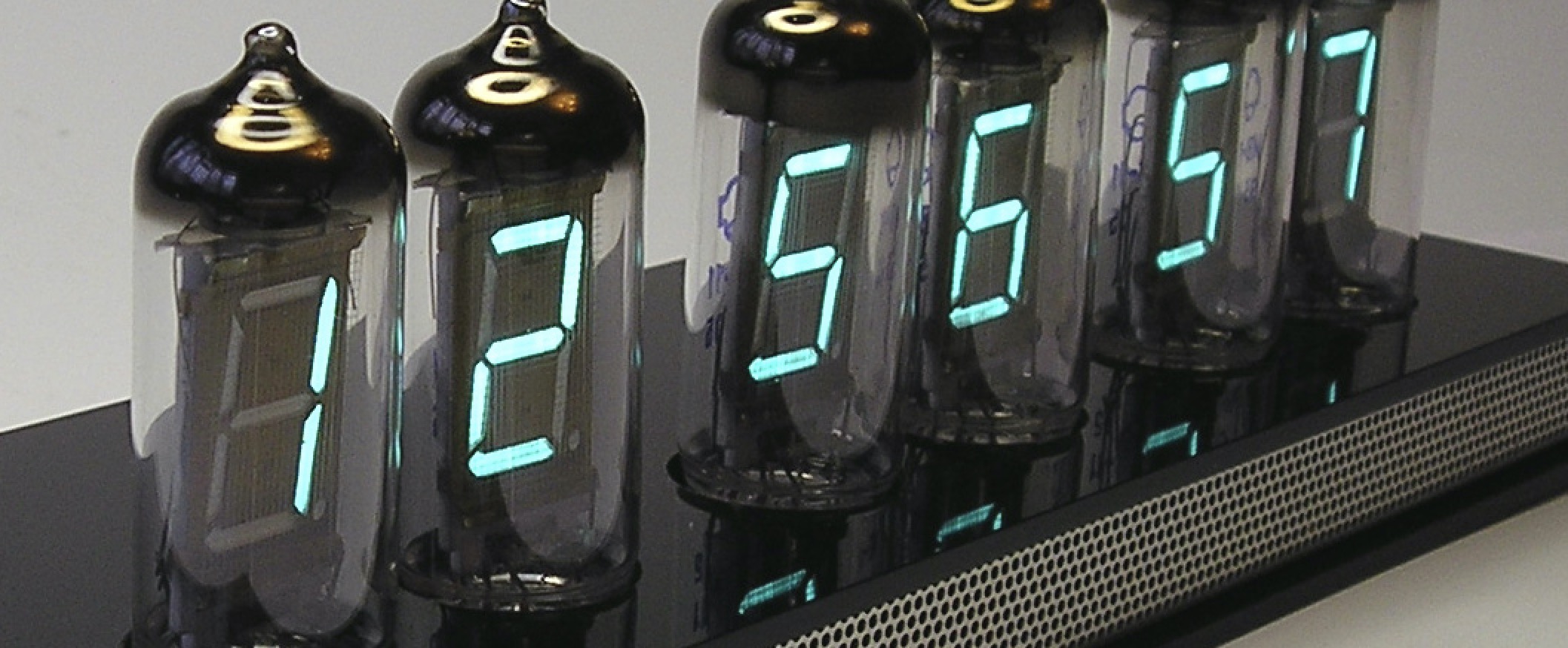
Vacuum fluorescent displays (VFDs) and nixie tubes both give a clock a retro glow, but they work in very different ways and do not look the same. Here is what sets them apart.
How a VFD works
A VFD is a vacuum tube containing a very thin heated filament (the cathode), a fine control grid and anodes coated with phosphor, usually shaped as segments. Electrons emitted by the filament strike the phosphor-coated segments, which glow – most often in blue-green. VFDs run on low voltages, a few tens of volts. Developed in Japan in the late 1960s, they became everywhere in the 1970s to 1990s: calculators, hi-fi equipment, video recorders, microwave ovens, cash registers and car dashboards. Soviet tubes such as the IV-11, a seven-segment VFD, are popular with clock makers.
How a nixie tube works
A nixie tube contains no filament. Ten metal cathodes shaped like the digits 0 to 9 are stacked inside a tube filled with neon. At about 170 V, the gas around the selected cathode glows orange, lighting up a complete, real digit.
Nixie vs VFD at a glance
| Nixie tube | VFD | |
|---|---|---|
| Principle | Glow discharge in neon gas | Phosphor lit by electrons in a vacuum |
| Digits | Complete numerals, stacked at different depths | Segments in a single plane |
| Colour | Warm orange | Blue-green (other colours with filters) |
| Voltage | About 170 V DC | Low: a few tens of volts, plus the filament supply |
| Look | Vintage, three-dimensional | Retro-electronic, crisp and flat |
Which one should you choose?
It is mostly a matter of taste. VFDs have a crisp, cool, eighties look. Nixie tubes, with their warm glow and three-dimensional digits, are the classic choice for a statement clock – and the one we specialise in. All our clocks are nixie clocks, assembled by hand in Paris; for a VFD project, ask me.