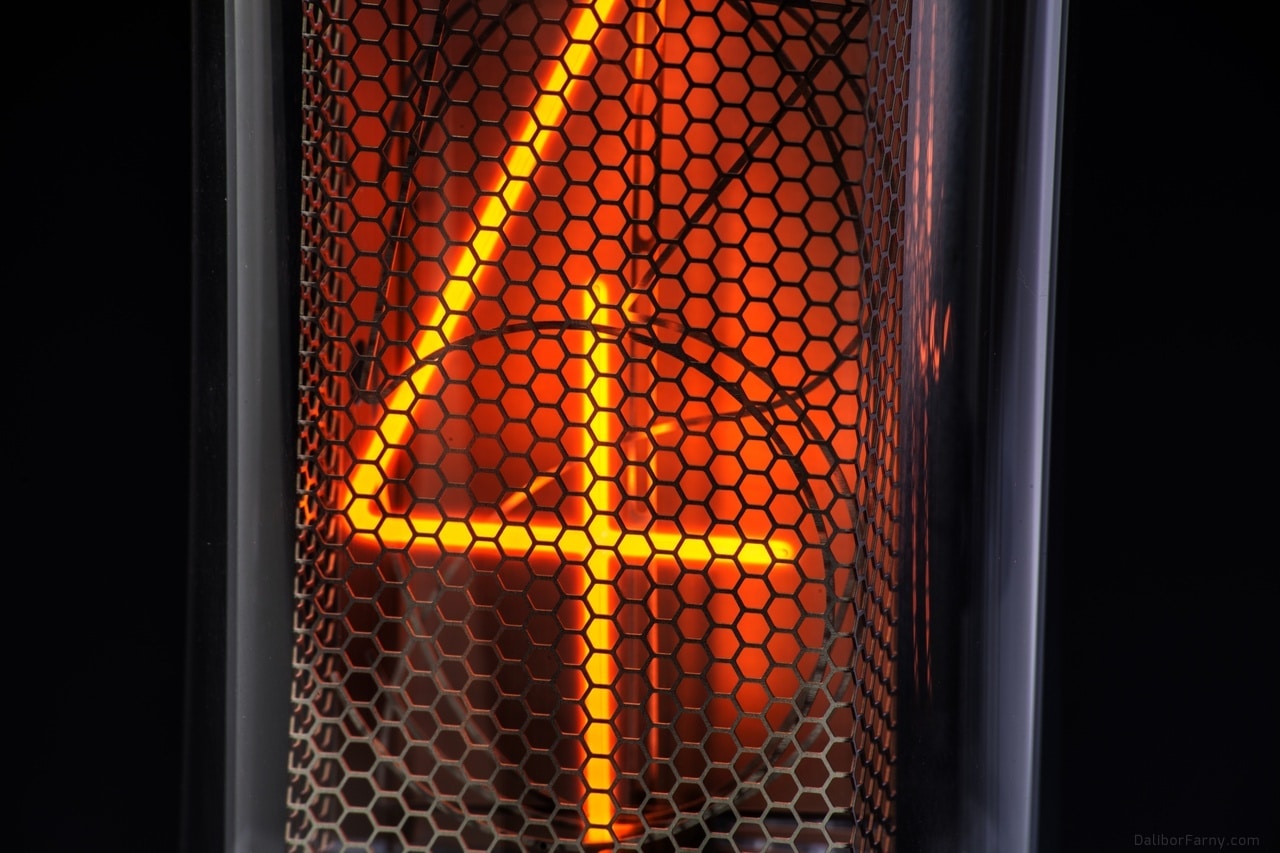
A nixie tube is a small glass display tube that shows a digit as a glowing orange numeral. Invented in the 1950s, it was the standard way to display numbers on electronic instruments until LEDs replaced it in the 1970s. Today nixie tubes are prized for their warm light – and they are the heart of every Nixie Boulevard clock.
How a nixie tube works
Inside the glass envelope, ten thin metal cathodes, each shaped like a digit from 0 to 9, are stacked one behind the other in front of a fine wire-mesh anode. The tube is filled with neon gas at low pressure. When a voltage of roughly 170 V DC is applied between the anode and one cathode, the gas around that cathode glows: the digit lights up in orange. Switching to another cathode lights another digit. Because the digits are stacked, each one appears at a slightly different depth – part of the charm of a nixie display.
A short history
The tube was developed by Haydu Brothers Laboratories, a small vacuum-tube maker acquired by the Burroughs Corporation, which introduced it in 1955 under the name Nixie – said to come from “NIX I”, for Numeric Indicator eXperimental No. 1. Nixie tubes were used in calculators, voltmeters, frequency counters and early computers. In the 1970s, cheaper LED and vacuum fluorescent displays running on lower voltages replaced them, and production stopped in the West. In the Soviet Union, nixie tubes such as the IN-14 and the IN-18 were produced for longer – which is why most nixie tubes available today are Soviet.
New old stock and new tubes
“New old stock” (NOS) means genuine vintage tubes that were manufactured decades ago but never used. Their supply is finite, which is why large tubes like the IN-18 are becoming rare. A handful of craftsmen make new nixie tubes today – among them Dalibor Farny in the Czech Republic, whose giant R568M tube powers our Solitube.
The tubes in our clocks
- IN-14 – a compact Soviet tube with 18 mm digits, used in our desk clock.
- IN-18 – the largest classic Soviet nixie, with tall, elegant digits, used in our six-tube clocks.
- ZM1042 – a rarer tube with large digits, used in our ZM1042 clock.
- R568M – a giant tube hand-made today by Dalibor Farny.
How long does a nixie tube last?
Lifespan depends on the tube and on how many hours it is lit. The main enemy is cathode poisoning: digits that are rarely lit slowly get covered by material sputtered from the active cathode and stop glowing evenly. Good clocks prevent it by regularly cycling every digit (the “slot machine” effect), and extend tube life further with a night mode and an optional motion sensor – features built into every Nixie Boulevard clock.
Are nixie tubes safe?
Yes, in a properly built clock. The high voltage the tubes need is generated inside the case from a low-voltage adapter, and the electronics are enclosed. Simply never open a clock while it is plugged in.