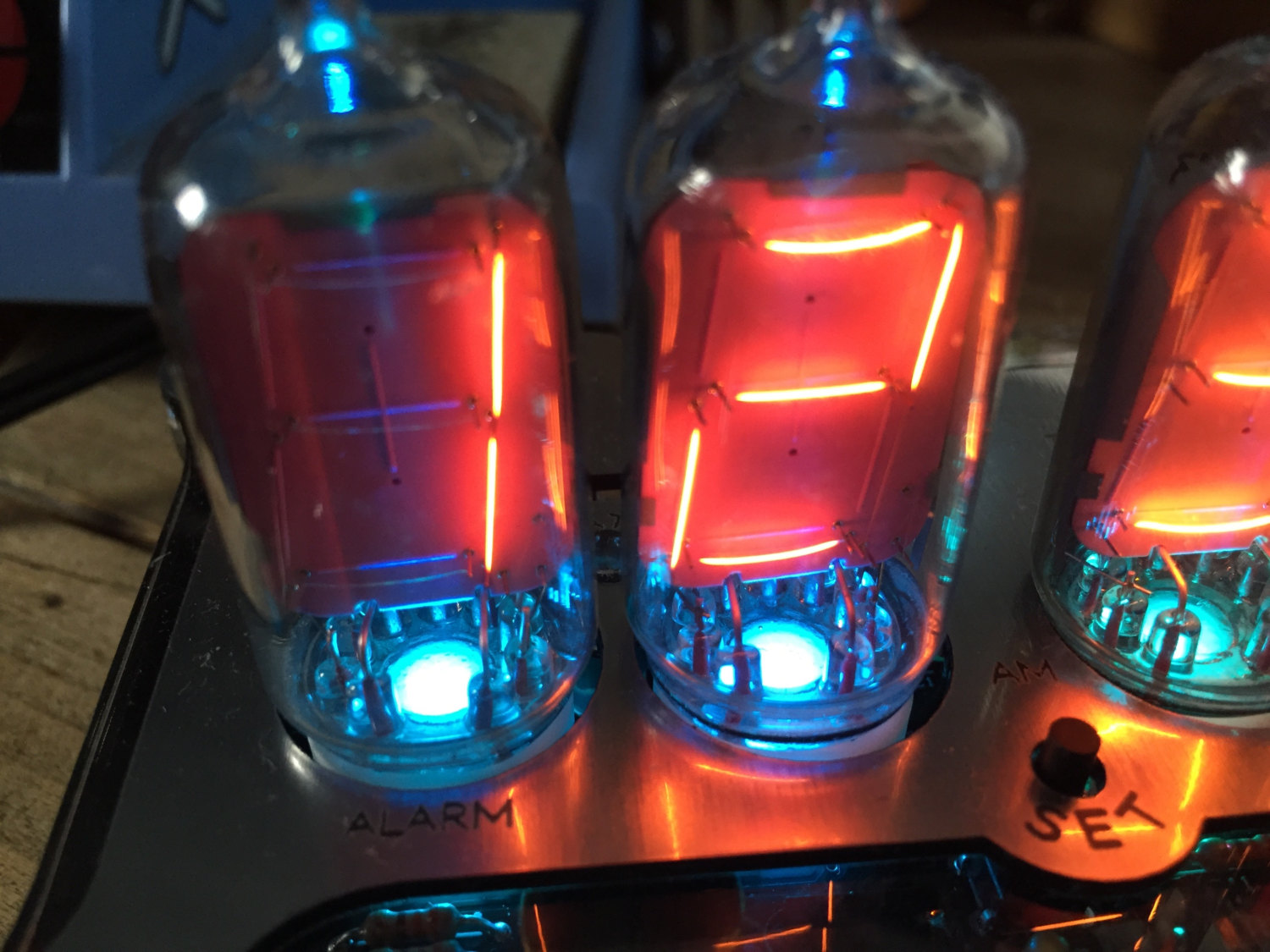
Numitrons and nixie tubes both come from the era before LEDs, and both make beautiful clocks. But one is a tiny light bulb, the other a neon lamp. Here is the difference.
What is a numitron?
A numitron is an incandescent display tube. Inside a small glass vacuum tube, seven thin filaments are arranged as a seven-segment digit, usually with an eighth for the decimal point. When current flows through a filament, it heats up and glows, exactly like the filament of a light bulb. RCA sold these tubes under the Numitron name in the 1970s; Soviet equivalents include the IV-9 and IV-13. Numitrons run on a few volts and are simple to drive, and their filaments remain visible inside the glass when switched off.
How is a nixie tube different?
A nixie tube has no filament. Ten metal cathodes shaped like the digits 0 to 9 are stacked in a tube filled with neon. At about 170 V, the gas around the selected cathode glows orange and lights up a complete digit.
Numitron vs nixie at a glance
| Numitron | Nixie tube | |
|---|---|---|
| Principle | Incandescent filaments | Glow discharge in neon gas |
| Digits | Seven segments | Complete numerals, stacked at different depths |
| Colour | Warm white to amber | Warm orange |
| Voltage | A few volts | About 170 V DC |
| Look | Fine glowing wires, very delicate | Vintage, three-dimensional digits |
Which one should you choose?
Numitrons have a delicate, almost jewel-like look; nixie tubes have the iconic orange glow and full numerals that most people picture when they think of a vintage clock. We specialise in nixie clocks, assembled by hand in Paris – ask me if you are looking for something else.



[…] Numitron vacuum tubes are sort of like Nixie’s poor sister. They utilize a seven segment display which makes them clearer to read. The tubes only require 5 volts making them ideal for use in an arcade cabinet. Very few bronze age arcade games use external displays for scoring. As a collector, it’s a real treat to see something like them in action. […]